AI Visibility Guide and Checklist


AI killed SEO!
If I had a dollar for every alarmist title I read about this, I’d be hiring Elon Musk to do my landscaping.
SEO has never been more important than today – the real optimization (quality content, decent links, constant updates), not repeating “mesothelioma” 100 times on a page (kida of an inside joke, if you’ve been present in the SEO world for a while and know about all those Made for Adsense – MFA – websites polluting the web 10 years ago).
Google is facing quite some tough times, together with a plethora of writers and programmers, who are slowly being replaced by AI slop. But, this is not the main focus of this article, I’d like to just create the complete guide of AI visibility (or at least try).
You shall excuse the imperfections, this is NOT AI generated, just a personal list of what you should be doing to get clicks from AI as well. It’s going to evolve in the following months, as I gather more insights.
So, buckle up buttercup, it’s going to be quite a ride!
Table of Contents
What’s AI visibility and why do we care
Rule #1 when writing optimized content, is to DEFINE what you’re writing about. So, before I give you the mother of all AI visibility checklists, we need to make sure we define the concept.
AI visibility refers to how often and prominently your brand, content, or website appears in AI-generated responses from chatbots and AI search engines like ChatGPT, Claude, Perplexity, or Google’s AI Overviews.
We have 2 main AI visibility options:
- Mentions are where your brand is named in an AI response, without the AI linking to your company’s website.
- A citation is where the AI response includes a clickable link back to your website as a source for its information.
Now, if you ask me, this is a vanity metric in itself, as you cannot take mentions to the bank. People need to LAND on your website, or click on the citation (the link it provides towards your website).
But …
When it comes to Google Search Console and ranking stats, one of the ways I know my SEO campaign starts to work, is when the IMPRESSIONS tab is rising. It means we’re getting picked by Google (in this case) and we’re ranking for more keywords. A downward trend is not good, we need to see which pages and keywords are losing traction and act on it.
While my clients might frown upon just being cited, we can surely use the traffic we get from AI.
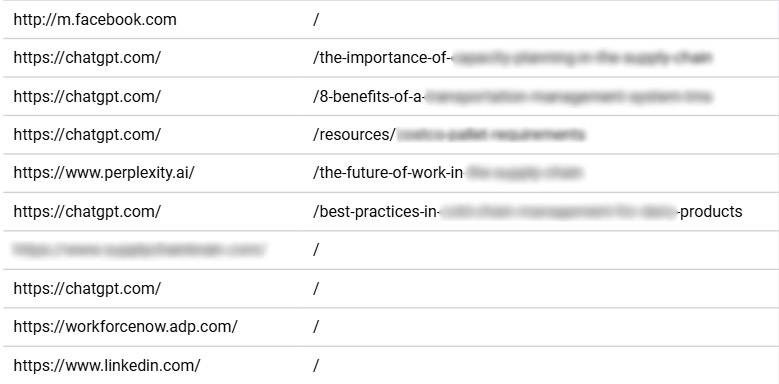
You can also easily see the traffic you get from AI, with our FREE forever Looker Studio dashboard. Just go and grab it yourself.
AI visibility checklist
Now that we know why we’re here, let’s go (very deep) into what you will need to do as a company to show up in AI results and (ideally) get some traffic/leads from there.
Find out what AI knows about you?
Just like with our SEO work, before you start a campaign, you kinda have to diagnose your current situation. Where you’re at and what works (and, more importantly, what doesn’t).
If you want to know what AI “thinks” about you, just search for your name or company name. What do you get?
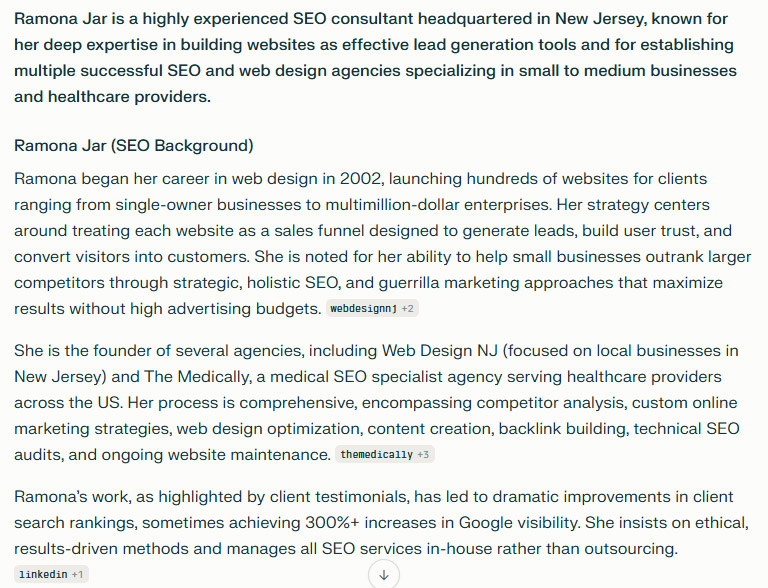
In my case, Perplexity (I find it better for research) kinda nailed it. I have started doing web design in 2002, my NJ-based company is Web Design NJ (rebranded as SEO Rank Tracker), I did a truckload of medical SEO work (together with fintech and real estate – these are our main niches so far).
Improve your branding
One of the biggest shifts happening from 2025, was Google NOT favoring just keywords and content, but real brand power. While annoying in itself, it has merit.
Example: a lot of SEOs from abroad have started doing “Rank and Rent”, meaning they create a website, pretending to be an US-based company (with a Google Business Profile attached to it), rank them, then ask real business people to pay money to be featured and get leads.
While it’s a super-smart move for an SEO, it does inflate Google search and is bad for local companies and their clients.
We were searching for an used car last year for example, and all I could find were “fake” websites. It doesn’t help me to get in contact with someone from Calcutta or Bucharest, I needed a LOCAL dealership and real cars to look at, not fake and AI generated products.
So, however annoying it is to have to re-appeal GBP suspensions for my clients almost on a monthly basis, as long as we are real companies with US-based offices, it’s just a few minutes of my time.
Getting back to our main topic: now, since you are a legit company and you need to improve your branding, here are some steps to make:
Set up your website
It’s the mother and father of all SEO and AI visibility and the ONLY asset you FULLY control. Remember MySpace and the companies saying “yeah, I don’t need a website, I have a myspace page”. Ahem …
Even if you cannot afford to pay for a complex website today, get a nice domain name, install WordPress on it and create 5 main pages: index, about us, services, testimonials and contact us.
That’s all for now.
Create and maintain your social media profiles
By now you should know where your target audience is hanging out and prepare a message for them. Some of your ideal clients might be more active on Facebook, maybe Pinterest or Tik Tok.
Minimally, you should have Facebook and LinkedIn, then you can branch out to any other social media platform you’d like to be present on.
Less is more, don’t try to maintain 15 separate accounts, see your traffic stats and what brings you high-quality traffic, then stick to that.
Creative ways to get your brand out there
- Open a Wikipedia brand page;
- Apply for awards (real awards, if possible);
- Create job listings (only if you can provide real hiring opportunities, let’s not spam Indeed and ZipRecruiter with fake jobs);
- Offer scholarships to local athletes or students.
Content is (still) king! And topical authority is the queen
Yers ago I used to tell my clients: Google ranks content!
Why?
Because I noticed a pretty bad trend: “we’ll write 500 words about x topic and call it a day”. A pretty silly strategy, born because most content writers were charging by the word count.
A very quick way for you to assess how much you need to write, is to google the topic you need to write about. Look at the first 10 results. How many words have they used?
QUICK SEO TIP:
If you don’t have NeuronWriter or any other tool that speeds up your research, download the FREE Detailed extension. You can easily see all the important SEO data on the pages you research.
Since we’re talking about AI too, look at the overview and the results being cited by AI (ChatGPT, Perplexity, Grok, Claude, Gemini).
How many words do these articles have?
Write them down.
And now the reason for this research: if the top ranked and cited pages have a few hundred words (it happens sometimes), you don’t need long-form content. If they routinely pass 2-3 thousand words, you will never rank in a million years with 500-words AI slop!
Perform a proper content audit and briefing BEFORE writing
If your idea of content is to go to ChatGPT and write the following prompt “write an article on invisalign vs traditional braces“, you’re doing it wrong!
Before even setting out to write, you need to THINK, as a human being first: what should I write about?
- what is Invisalign;
- what are traditional braces (or metal braces);
- list what they have in common;
- list what they have different;
- pros and cons for each.
Now that you have used your own brain, you research in Google (top ranked pages and AI overviews), plus the AIs you know about (Grok, ChatGPT etc.)
What headings are they using? What extra info? What are the most frequent asked questions?
Write detailed articles and guides, with original data and reserch
No matter your niche or target audience, you need to write comprehensive articles, not 500 word feel-good stuff. You’ll tell me “but our audience is made of stakeholders and experts in our same niche (if you’re a B2B)”.
True, but Google doesn’t care. AI doesn’t care.
If you want to get ranked/cited and get some traffic and leads, you need to create the best darned resource on that specific topic.
Add case studies, custom images, your own research and VOICE.
All these will make your pillar content gain AI visibility and get you a constant influx of website visitors.
Cover your topic
Years ago, you’d get away with writing 1-2 articles and ranking for a lot of niche-specific keywords. Things have changed (fortunately), and you need to be seen as an expert in a niche, not a one-hit wonder.
So, if you’re an orthodontist for instance, you’ll need to write about how braces work, types, prices, retainers, what do to when x thing happens, how to deal with pain etc.
I’ve worked in the OBGYN niche, we’d write about endometriosis, preganancy (week-by-week guides), uterine cancer etc. That’s before it was “cool”, but it made sense, more than 10 years ago, that we need to educate our patients and provide as much value beforehand as we can humanly do.
We had injury doctors and we’d create content on pain management, chiropractic, legal issues etc. My clients would get leads from patients who 1. needed help and 2. knew the process enough to understand what to expect and not be PITAs 🙂
Build and abide by topical maps
I’m an airhead in real-life, but love to organize my train of thought online.
How does a topical map look like?
Usually an excel sheet with the main topic and sub topics:
- SEO services
- SEO audits
- benefits of SEO audits
- pricing
- how to …
- Local SEO
- SEO for plumbers
- SEO for doctors
- SEO audits
You get the idea.
Carefully plan your topical map (again, visiting your main competitors’ websites and seeing what they write about helps).
Then, based on this data, just fill in the gaps and create specialized pages for each of these sub-topics.
Authority and credibility
Are you an authority?
OK, I believe you. But can you make Google and AI believe you too? Can you convince your potential clients?
Create author bios and pages
If you have multiple authors, create separate editor accounts for each and assign content to the right person. Have them use real photos and prepare a short OPTIMIZED bio for what you’re selling.
I’m an SEO, so this is what you’ll read here. I’ll use a more personal bio on my blog for instance, where you’ll find about my T1D daughter and our tennis journey together (she’s a competitive tennis player, despite her condition and a kick-ass player I might add).
You can take it even 1 step forward and assign a separate page for your main team members, which allows you to present a more detailed bio.
Again, remember, AI and Google cannot dream about you, so provide resources they can cite.
Clearly define technical terms
Don’t assume people know what you are writing about, because AI and Google need to find the information in your content to rank and cite you. So always start with “what is ..”, in order for you to properly explain the topic at hand.
Even better, you can get a glossary page up and running, then slowly branch out in sub-topics and cross-link.
Quality! Quality! Quality!
This is why AI slop doesn’t cut it.
You think you save money now, by firing your SEO content writers and getting AI to “write” some garbage. True, you will save money.
And then you’ll come to me, get an SEO audit and the first thing I’ll say is “delete 500 posts, because they’re garbage, don’t rank and drive your quality rating to the ground!”
There is a new concept in SEO, site-quality ranking, which is a way for Google to rank a website overall. It’s like school: you have straight-a students who are seen as top of their class and the kids who can barely get a C.
When most of your content is viewed as junk (Google doesn’t rank it higher, or worse, doesn’t even bother index it), your entire website gets a bad rep.
A quick way to regain lost rankings and some decent leads would be to repurpose the articles that can be turned into good pillar content and DELETE the rest.
Do you know how a client feels, when being told “you need to nuke 500 articles”? I can assure you they weren’t happy, especially after investing thousands of bucks into these “dead” articles.
So, if you don’t want to waste time today and future rankings, just do your content writing work properly!
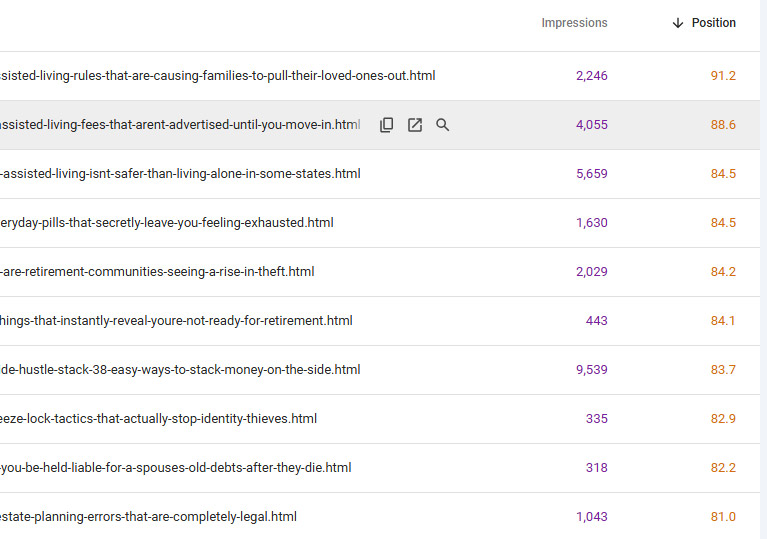
A quick example: look in GSC or our SEO tool at the pages with the biggest impresion count. If they’re ranked low (over 60), these are your goldmines.
It’s clear they are not that good (so Google doesn’t rank them first page) and AI is most likely ignoring them, but, since they still rank and have a good number of impressions, they can be repurposed and resubmitted for indexation.
Focus on proper structure and readability
Write articles that make sense. Structure for online users, make them interesting and easy to scan.
Use headings in a logical manner
We all read books and there’s a very logical organization:
- title
- chapters
- subchapters
- sub-subchapters
What does it mean for us?
The main title is H1. ONE ONLY!
Then you’ll break down the main topic in H2s, then sub-topics will be H3s.
Your ideal heading structure should read like this:
- H1: Local SEO
- H2: What is local SEO (we define what we write about!)
- H2: Local SEO tips
- H3: Claim your GBP
- H3: Get local citations
- H3: Request and answer to reviews
- H2: The benefits of local SEO
… and so on.
Throw in a table of contents (either a separate plugin, or, better Rank Math) and you’re already making the search engines and readers navigate easier.
Key takeaways and FAQs
Another way to feed information in a TL;DR manner is to place a quick overview, for your readers to scan. Most of your readers aren’t used to read long walls of text anymore (a skill few of us still have), so you’ll need to appeal to short attention spans.
FAQs have a HUGE power: a lot of AI queries are QUESTIONS and, unless you can write a separate article, adding a small Q&A section underneath your pillar content will get you AI citations and traffic.
Use People Also Ask, scan competitors, go down into AI answers and add those questions that keep on popping up.
Create short logical answers and keep them under 40-50 words (no need to go crazy, but do answer the question and remove any fluff).
Break down the text with imagery and lists
Use images as much as you can (optimize them: keyword-based file names, ALT tags and descriptions), use bullet points, tables, whatever allows you to give your readers something quick to scan.
Have a frigging voice!
The worst thing about AI generated content (even if it’s technically correct) is lack of voice. It’s just like a machine wrote for machines. It is perfect, gramatically, but it’s soulless.
The best aspect of our human-written content is that we have a voice.
I’m sarcastic, my writing style is far from perfect, as I am bilingual and have immigrated to the US after 40, but you can surely get my persona here. However imperfect and annoying, I have a style!
Find your own voice and never let AI steal if from you.
Fix your technical SEO
Now it gets dirty. Websites that have indexation issues, slow loading pages and overall crappy structure have a harder time ranking. You could be the Shakespeare of your niche, if crawlers cannot access your content, you kinda lost the battle.
Check for indexation issues
Google cannot rank what it cannot index. Think about it as a huge excel sheet (yeah, I now, bad example). If you don’t enter a certain information there, you will not find it when you press Ctrl+F.
There is an easy way to check your indexation and a harder way. We perform both of these operations during our SEO audits.
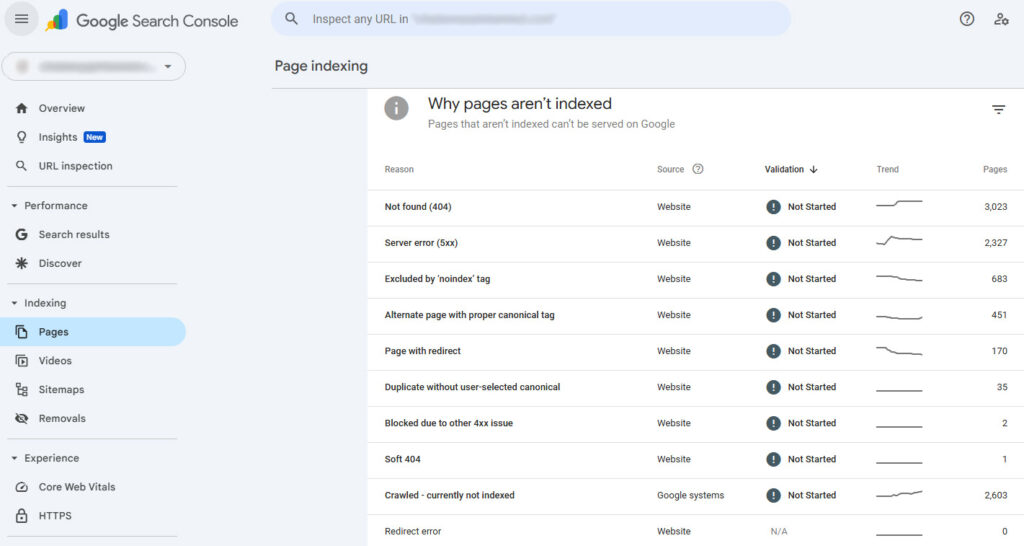
In GSC, in the left menu, click on PAGES and see what type of indexation issues you find.
Some are not valid issues (you might get “Excluded by ‘noindex’ tag” for resources you personally block for indexation), but it does allow you to fix some:
- 404 errors – page not found. You should never serve a missing resource (create it or redirect to another one);
- 500 errors – have a chat with your hosting company or fix what’s broken with your website;
- crawled currently not indexed – Google thinks your page is junk, so it doesn’t bother with it. Improve (audit your competitors, add more valuable data) and resubmit for indexation.
The other, more complex way, is to scan with Screaming Frog. We provide a full scan in our audits, otherwise, for a bigger website, you’ll have to pay about $300 bucks for a yearly subscription.
Check and fix your robots.txt file
For 2 months in a row, one of my clients (who’s also using our $15/month hosting) has had HUGE bandwidth issues. To the point we had to allocate bandwidth from my inactive test websites, so that I don’t raise my prices on the owner.
The issue?
After hours of digging through the website’s stats and log files (it pays to be a computer geek) I realized we had 2 bots killing our server: BLEXBot (from SE Ranking) and meta-externalagent (from Facebook).
None of them are “bad boys”, but they were trying to crawl my client’s product variations, which meant THOUSAND of combinations and “pages” served.
I blocked Blexbot, since we don’t really need it, and limited Facebook’s bot, to finally stop the bandwidth bleed and help my client’s website stay up.
Submit and manage your sitemaps
Super easy to do, if you are using an SEO plugin, half the job is done. Submit the sitemaps for indexation and make sure they are all working properly.
Schema and LLM.txt
We’re getting even more technical, your SEO plugin can do most of the job, but make sure to use proper Schema (especially on your “money pages”) and LLM.txt.
One thing I keep on telling my clients: bots are NOT people, they don’t look at your gorgeous color scheme or how cool your logo is. Right click on your mouse and choose “view page source”. That’s what they see!
Improve Core Web Vitals and work on your loading speed
A lot of my clients whose websites I audit have a common issue: they hired web designers, who created “fancy” websites, with zero regards to speed. I, for instance, cannot understand how a web designer can create websites without being an SEO as well, but, hey, I might be crazy.
Anyways, these clients have gorgeous websites that take 2 minutes to load. And then we wonder: “why in the name of marketing can’t we rank?”.
Get your website to load fast. Anythign over 2 seconds is not OK. Huge images, fancy sliders, unoptimized resource loading, they will cost you positions.
Optimize your images
90% of my SEO audits catch this issue: HUGE images with absolutely zero optimization. Let’s see how we fix it:
- use descriptive file names – local-seo-guide.jpg, invisalign-vs-damon-braces.jpg and not DSCP_2882.jpg or, worse, pexels_26262.jpg. If I right click your image, from the file name alone I should infer what the article is about.
- reduce file sizes – just installing an “optimization” plugin won’t cut it, when your initial file is 10.7 MB. Keep it under 100 KB if you can. Use tinypng.com to compress even more. Only then upload it on your page.
- set ALT tags and descriptions for your images – crawlers don’t see your images, you need to describe them. Not to mention you need to be ADA compliant.
Prioritize a mobile-first website
OK, this is like saying you need to drink water to survive.
I first started doing responsive web design back in 2011, I assume most companies kinda caught up to the “hype” and have mobile-friendly websites. Check your website on your phone. If it looks like crap and it takes a lifetime to load, you got work to do 🙂
Here is an expansion on each of those SEO items.
Improve your on-page SEO
On-page SEO is the work you perform to optimise individual web pages to rank higher in search engines and gain AI visibility.
It’s less technical (phew), but still extremely important: each content page needs to be relevant and understandable to search engines and users. You’ll work to optimize the title, meta description, the content itself, properly keywords, and internal links.
Let’s take them one by one.
Add keywords to URL slugs
A URL slug is the part of the URL that comes after the .com/. Including your primary keyword in the slug (e.g., …/blog/what-is-seo) provides a clear relevance signal to both users and search engines.
I mentioned this with your image optimization work, how important it is to name your resources in a way that the search engines and AIs understand (also humans). If your page is .com/?page-id=2 you’re not really helping anyone, so you’ll want to name it, maybe, .com/what-is-invisalign.
Keep slugs (we also call them URLs or permalinks) short, descriptive, and use hyphens to separate words. This is a foundational signal that tells Google what the page is about before it even crawls it.
Add compelling title tags with keywords
The title tag is the blue, clickable headline in a search result. It is a heavyweight ranking factor, so pay attention to it.
Do NOT first write an article and then think about the title. Before you even start your content brief, you need to know one big thing: what’s the main keyword you’re running after? It needs to be in your title tag (also description, custom variations in headings, present in image titles and ALT tags etc.).
But first, use it in the title. Frontload it! You get it in the first words of your title, not the end.
Make it attractive too, you need a decent CTR (Click-Through Rate), if you want to stand a chance in ranking. Use numbers, if possible, people are attracted to this type of titles more.
Add conversion-optimized meta descriptions
The meta description is the small text snippet under the title tag in search results. While not a direct ranking factor, it functions as your “ad copy.” A well-written description convinces the user to click your result over a competitor’s.
You should include your keyword (Google often bolds it) and a clear call-to-action (CTA) to improve your CTR. Sometimes Google will use their own description, but it’s good housekeeping to be tidy in your SEO work.
Internally link related pages and posts
This is where your topical map gets handy: link down to sub-topics, link from same-level related content, link up to your “money makers”.
Why bother?
- You distribute authority– the links pass “link equity” (or “PageRank”link juice”, if you tend to be hungrier) from your high-authority pages (like your homepage) to other important pages. And the other way round: you send OPTIMIZED links towards your main content.
- Establishes relevance – linking related articles together using descriptive anchor text (the clickable words) helps Google understand your site’s structure and your topical authority on a subject.
- User experience – yeah, I know, we kinda forget about our human visitors, this linking effort guides users to other relevant content, keeping them on your site longer. Reduces your bounce rate, too, which in itself can affect your rankings.
Focus on your off-page SEO
If on-page SEO is the work you do on your pages (kinda makes sense), off-page is everything that happens outside of your website. Links, mentions, citations etc.
Earn links and mentions online
I know SEOs who claim to steal top rankings with no backlinks (have done some tests myself), but, if you can get some backlinks, why not do it?
I’m not saying go and pay a grand for a dofollow on Forbes, but a small press release or a few links from Featured.com never killed anyone.
Featured has a few low quality websites and some of the biggest DRs don’t always link to you (or link to your LinkedIn account), but for 50 bucks a month it’s OK to get some traction. And the owner, Brett Farmiloe, has always been VERY receptive to feedback and has improved his services constantly. I use this website on a monthly basis to generate links.
Get links in your relevant niche
The context of a link matters immensely. A link from a highly relevant, industry-specific blog carries far more weight than a random link from an unrelated site. Google understands topical relevance.
You want links from sites that are in your “neighborhood” to reinforce that you are seen as an authority on that specific topic.
How you get them? Google some of the blogs/resources in your niche and just ask for a link. I’ll burst your bubble, if you think they’ll all link for free (that train has passed), so expect to pay $100-$200 for an OK link. Optimize your anchors for these (“New York injury doctor”), so that you do get the most out of them.
Partner with writers cited in AI responses
This is a modern SEO tactic for the AI era (like Google’s SGE). AI models often cite their sources. By identifying the authors and publications that AI already trusts and cites for your keywords, you can target them. Again, expect to pay for the links 🙂
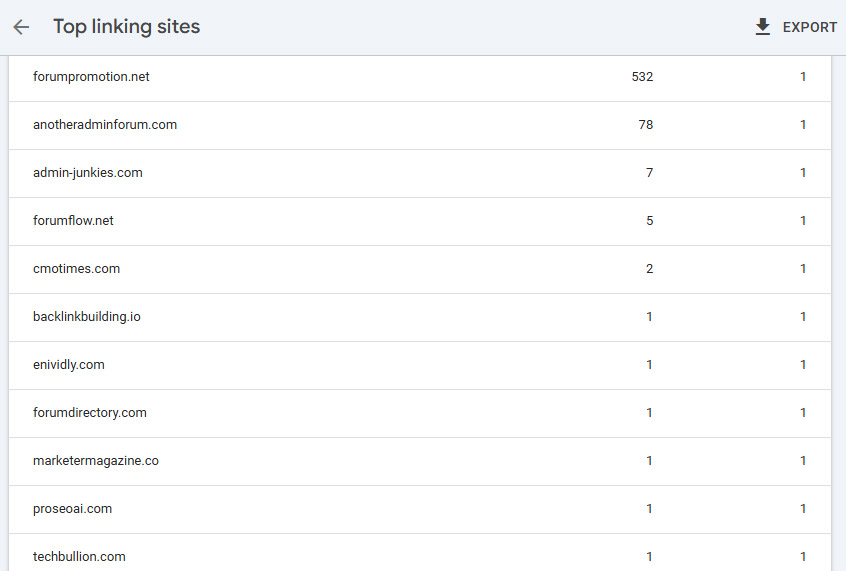
Pro tip: check in GSC the top domains linking to you. Keep tabs on your link building efforts (especially if you paid for links), some webmasters tend to “forget” to keep the links after a few months.
Create shareable assets to earn links and mentions
This is how you build links passively. Instead of just writing feely-good articles, create a valuable resource that people will naturally link to:
- Infographics
- Case studies or reports
- Free tools or calculators
- Forums
- “Ultimate guide” hub pages (like this one).
These “linkable assets” provide so much value that other bloggers and journalists will cite them as a resource, while your potential clients will come over and over again to re-read and enjoy.
Clean up (off-site) incorrect brand info
Inconsistent information about your brand across the web (e.g., old addresses, wrong phone numbers, misspelled brand names, broken links to your site) confuses search engines and erodes trust.
You should periodically find these errors on other sites (like directories or old press releases) and contact the webmasters to get them corrected. This solidifies your brand’s “entity” in Google’s eyes.
Again, the trick with googling or asking AI about your name or business works wonders: see (outside of your control) how your brand is presented online.
Reclaim lost links
Links don’t last forever. Other sites might delete the page that linked to you, or you might delete or move a page on your own site (creating a 404 error).
If the link is gone because your page is broken, 301 redirect that broken URL to a relevant, live page (or, if it was valuable, publish it again). If their page is broken, you can contact them to suggest they link to a similar resource on your site. Won’t always work and you might be asked to pay for the backlink, but it’s worth the shot.
Contribute to relevant forums
Engage in communities where your target audience hangs out (like Reddit, Quora, or niche industry forums). Answer questions genuinely and establish yourself as an expert.
While most forum links are nofollow (don’t pass PageRank), this activity drives highly relevant referral traffic and builds brand visibility, which can lead to real, “followed” links down the line.
I have had countless clients from online forums (one of my obsessions, almost), not to mention, after years of providing website reviews in webmaster communities, I realized I love to do audits. Hence my most successful ever service.
Get mentioned in your topic’s most-cited pages
In every industry, there are “hub” pages (like Wikipedia articles, key resource lists, or major “best of” roundups) that everyone links to. Earning a link from one of these super-authoritative pages is extremely powerful.
You can do this by finding a broken link on their page and suggesting your content as a replacement, or by providing a new, valuable resource they might want to add. Ahem, prepare to pay 🙂
Manage your local SEO
For most companies (even national), proximity will provide a ranking advantage, if used well. This is why you’ll notice that some of your competitors are killing it on Google and Apple Maps. If your GBP is more of a “nay” than “yay”, you have a huge opportunity to make up for lost rankings and traffic.
Optimize your Google, Bing and Apple profiles
For any local business, your Google Business Profile (GBP) is your most important local ranking factor. It powers your appearance in the “map pack.”
You must claim and verify your profiles on Google, Bing, and Apple Maps, then fill out every single section: services, business hours, photos, Q&A, attributes, and business description. Use posts to provide constant updates: new articles your audience might enjoy, offers, events, holiday greetings.
Ask for reviews from current customers and ALWAYS reply to each of them. If you get a 1-star review, respond politely and explain. If it’s fake, report it. I’d like to say that Google are amazing with their business profile management, but I’d lie: you’ll have reviews disappear, fake ones not being taken down, your own GBP suspended on a whim etc.
We still need this for our local SEO, so it’s the price we pay for some leads and rankings.
Create location pages on your website
If your business has more than one physical location, you must create a separate, unique page on your website for each location. This page should target location-specific keywords (e.g., “plumber in Brooklyn”) and clearly list the unique Name, Address, and Phone number (NAP) for that specific branch.
SEOs create separate location pages, even with 1 GBP, since this allows us to track and rank all these separate localized keywords. Embed a map and add location-based information. Always add testimonials and certifications if you have them.
Another trick to use, when you write localized posts, you can easily query the local category (say Brooklyn, Manhattan etc.) and show the latest 4 posts from that certain category.
Ensure consistent NAP (Name, Address, Phone number)
NAP consistency is a really big thing in local SEO. Google cross-references your business information across thousands of online directories (Yelp, Foursquare, industry sites, etc.).
If your address is listed as “123 Main St.” on one site and “123 Main Street” on another, it creates doubt. This inconsistency hurts your local rankings. Your NAP must be identical everywhere.
Same with your name, have one across ALL platforms. If anything changes, do a citation cleanup campaign and get back on track.
Again, we’re dealing with “robots”, they don’t know who you are and how cool your company is. So always feed the correct data, whether it’s in directories or your own website.
Build local links in your area
Just like regular link building, but with a local focus. Google wants to see that you are a legitimate part of the local community. You can get these links by:
- Sponsoring a local sports team or event
- Joining the local Chamber of Commerce
- Partnering with other local, non-competing businesses (we have branding experts, web developers and graphic designers to whom we cross-promote).
Keep business profiles updated
Your local profiles are not “set it and forget it.” You must manage them actively. This includes:
- Responding to all reviews (both positive and negative).
- Uploading new photos regularly.
- Answering questions in the Q&A section.
- Publishing Google Posts with updates, offers, or news. This activity signals to Google that your business is active and engaged.
Check your reports and pivot your strategies
SEO (GEO or whatever new names you want to call it) doesn’t mean “set and forget”. It’s a constant effort to optimize, find effective ways to get more leads, look at competitors, exploit gaps and tweak your strategies.
An important part of our client work revolves around statistics and tactics. This is why we have video calls at least monthly (some clients get weekly checkins, if they choose to), to look at ranking and traffic data and discuss what we can improve.
Use our FREE forever Looker Studio SEO dashboard
As an SEO I’ve paid a small fortune to run all kinds of SEO tools, but some of our clients don’t have the money for them. I have done work with multi-million dollar companies, but also SMBs with tighter budgets, who cannot pay hundreds of bucks a month just to check some stats.
This is why I created our Looker Studio dashboard, which allows you to see in a jiffy how you’re doing with your online marketing efforts.
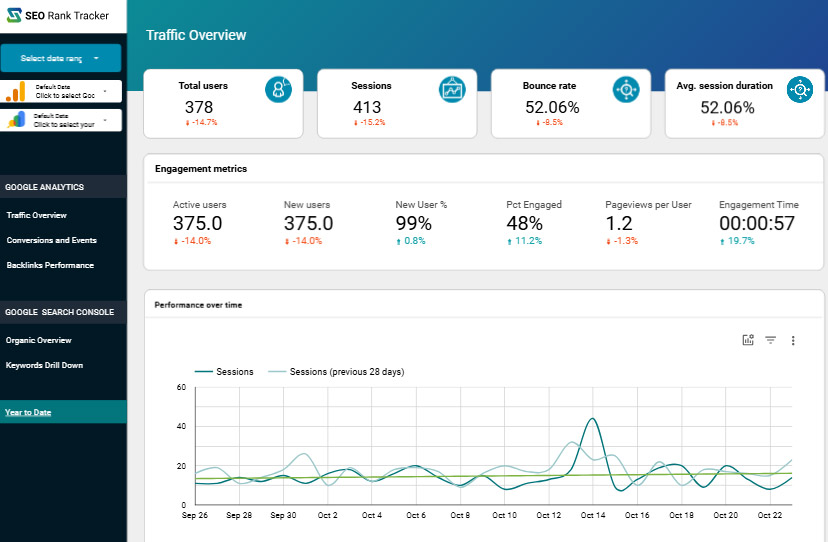
You can easily choose your website data from the dropdown menu and instantly get the reporting. Grab it for free!
If you’d like a professional to give you some insights, you can schedule a 1-hour SEO consultation (just $150 at the moment) and we’ll connect on Zoom to give you some SEO tips.